
If your organic traffic is flat but your rankings look fine, you’re not imagining things. The rules of search have changed. AI systems are selecting sources rather than simply surfacing them. Users are getting answers without ever clicking a link. And businesses that understand this shift are pulling ahead quickly.
Here’s exactly what’s happening, and what you need to do about it.
Search Engines Aren’t Dead. But Answer Engines Have Changed the Game.
The rise of AI-generated responses (Google’s AI Overviews, ChatGPT, Perplexity, Gemini) has fundamentally changed how people find information. Instead of scanning a results page and clicking through to websites, users increasingly get a synthesised answer right in the interface.
This is the shift from search engine to answer engine. It changes everything about how visibility works. The traditional click-based journey (user searches, scans results, visits your page) is becoming less common by the month.
People don’t want to scan a SERP. They want a fast, direct response to their question.
The 10 Shifts You Can’t Afford to Ignore
1. More Searches Are Ending Without a Click
A significant and growing share of Google searches now end without a click to an external website. For queries that trigger AI Overviews, that number is even higher. Being present in the answer is now the metric that matters, not just driving the click.
How to adapt:
- Optimize for featured snippets and AI Overview inclusion, not just blue-link rankings
- Write direct, structured answers to common questions in your space
- Shift success metrics from traffic volume to search visibility and brand impressions
2. AI Generates Answers Instead of Listing Links
When someone asks an AI search system a question, it doesn’t hand them a long list of links. It builds an answer from multiple sources and delivers it directly. Your content either gets cited or it doesn’t. The days of “just rank” are over.
How to adapt:
- Lead every section with a clear, direct answer rather than a slow buildup
- Use strong descriptive headings that signal exactly what information follows
- Write with the authority of a primary source, not a summary of other sources
3. Authority and Entities Matter More Than Keywords
AI systems don’t just match keywords. They understand entities (distinct concepts like businesses, products, or places), relationships, and context. They know which terms belong in a finance article versus a medical one. Keyword density doesn’t move the needle the way it used to.
What actually signals relevance now is topical depth, entity consistency, and how well your content maps to a coherent subject area.
How to adapt:
- Build content clusters around your core topics rather than targeting isolated keywords
- Use consistent terminology throughout your site to reinforce entity relationships
- Strengthen internal linking so AI systems can map the topical structure of your content
4. Content Needs to Be Structured for AI Retrieval
AI systems pull answers from content that’s organized for parsing. Structure is no longer just a UX best practice: it’s an extraction requirement. Think of your content as reference material that an AI system needs to read, understand, and cite accurately.
How to adapt:
- Implement schema markup across key page types
- Break content into clearly labeled sections with specific, informative headings
- Use bullet lists, numbered steps, and tables where they make information faster to process
5. Long-Tail and Conversational Queries Are Increasing
Voice search, AI assistants, and natural language interfaces have changed how people type and speak their queries. Searches are longer, more specific, and phrased like questions: “What’s the best approach for a small retail business?” rather than “retail SEO.” Shorter generic keywords are losing ground to intent-rich, conversational queries.
How to adapt:
- Build out FAQ content that mirrors how real people phrase real questions
- Write in a clear, direct tone that matches conversational search patterns
- Target question-based queries with dedicated sections or standalone pages
6. Brand Mentions and Citations Are Replacing Rankings
In AI-generated answers, your brand might be mentioned without a link. That citation still carries weight. It tells AI systems and users that your brand is a recognized authority. Getting cited matters more than ranking number one when nobody scrolls past the AI Overview.
How to adapt:
- Publish content that is genuinely citation-worthy: original analysis, clear expertise, specific points of view
- Earn mentions in industry publications, third-party directories, and authoritative sources
- Track where your brand appears in AI answers, not just where it ranks in the SERP
7. Traditional SEO Metrics Are Becoming Less Reliable on Their Own
Traffic alone doesn’t tell you how visible you are anymore. A page that gets cited in AI Overviews hundreds of times a day may show low click-through rates while still driving real brand awareness and trust. Measuring only sessions and clicks means you’re missing most of the picture.
How to adapt:
| Old metric | New or additional metric |
|---|---|
| Organic traffic volume | Search visibility and brand impressions |
| Click-through rate | AI citation frequency |
| Keyword rankings | Featured snippet wins |
| Page views | Brand mention volume across platforms |
Build a measurement framework that captures visibility across AI-driven surfaces, not just traditional SERPs.
8. Content Depth and Topical Coverage Matter More
Thin content (pages that touch a topic without really covering it) is losing ground fast. When an AI system needs to synthesise a complete answer, it gravitates toward sources that provide complete information. A single well-researched guide consistently outperforms a collection of shallow posts covering the same ground.
How to adapt:
- Build topic clusters with a strong pillar page and supporting subtopic content
- Cover your subject areas thoroughly, including angles your competitors skip
- Use internal links to connect related content and signal topical depth to AI systems
9. Technical SEO Still Matters, Just Differently
Technical SEO hasn’t gone away. Its job description has changed. AI systems need clean, accessible, well-organized content just as much as traditional crawlers do, and they’re less forgiving of structural confusion. Site architecture, crawlability, and structured data now directly influence how well AI systems comprehend your content.
How to adapt:
- Audit your site architecture to ensure the content hierarchy is logical and clear
- Fix crawl errors and indexing issues that block AI systems from accessing your content
- Implement structured data markup wherever it applies: articles, FAQs, products, reviews, local business information
10. AI SEO Is Now a Competitive Advantage
Early movers in AI search optimization are compounding their advantage while others wait. The businesses getting cited in AI Overviews and generative search results today are building brand authority that becomes increasingly difficult to displace. This isn’t a trend to monitor. It’s a strategic decision to make now.
How to adapt:
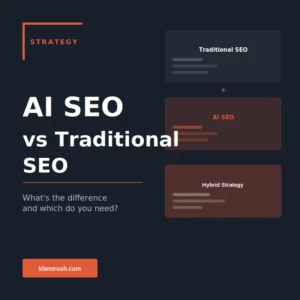
- Invest in an SEO strategy that addresses both traditional rankings and AI citation optimization
- Work with an agency that understands generative engine optimization, not just classic search
- Build your AI search presence while the field is still forming and the entry bar is lower
The Bottom Line: Rank and Get Cited. You Need Both.
SEO isn’t going away. It’s evolving into something more demanding and more strategic.
Rankings still matter, but they’re one input into a broader visibility equation. The businesses winning in AI search are the ones treating content as authoritative source material, building genuine topical expertise, and thinking beyond the click.
The core question in digital marketing has shifted. It used to be “how do we rank?” Now it’s “how do we get cited?” Answering that question requires a different approach, but the fundamentals (quality, structure, authority) are the same ones that have always defined good SEO. The bar is just higher.
Where to Start With AI SEO
Getting ahead of this shift doesn’t require rebuilding everything at once. Start here:
- Audit your current content. Identify which pages could be restructured for AI retrieval and which lack the depth to compete.
- Identify gaps in your AI search presence. Where are your competitors being cited and you aren’t?
- Optimize for AI extraction. Add direct answers at the top of key sections, implement schema markup, and tighten your internal linking.
- Expand your entity footprint. Earn mentions in third-party publications and authoritative directories in your industry.
- Rethink your KPIs. Build a measurement framework that captures visibility, brand mentions, and AI citation frequency alongside traditional traffic metrics.
Frequently Asked Questions
What is AI SEO?
AI SEO is the process of optimizing content and digital strategy for AI-driven search engines that generate direct answers, rather than relying solely on traditional rankings. It combines technical structure, topical authority, and entity optimization to make your brand a source AI systems recognize, trust, and cite.
How is AI changing SEO?
AI is shifting SEO from ranking webpages to inclusion in generated answers. Search engines now synthesise information rather than list links, which means businesses need to think less about keyword positions and more about being the source AI systems trust most. The shift is additive: AI SEO builds on top of strong traditional SEO, not around it.
Do businesses still need traditional SEO?
Yes. Clean technical foundations, strong backlinks, and well-structured content all support visibility in AI-driven search. Traditional SEO builds the foundation that AI citations depend on. The two strategies work together.
What are the most important changes AI has made to search?
The most significant changes are the rise of zero-click results (where AI generates the answer on the page), the shift from keyword ranking to entity citation, and the growing importance of content structure and schema markup for AI retrieval. These changes affect every business that relies on organic search for traffic and leads.
How do I know if AI search is affecting my business?
Check your Google Search Console data for declining clickthrough rates alongside steady or growing impressions. If your pages are being seen but not clicked, AI Overviews may be answering the queries before users reach you. Also test your key service queries in ChatGPT and Perplexity to see whether your brand is being cited.
Ready to Adapt Your SEO Strategy for AI Search?
The shift is already underway. The businesses investing in AI search visibility now are building a compounding advantage. Those waiting to see how things settle are falling further behind every month.
Get in touch with KlientRush to talk through where your current strategy stands and what it would take to show up in both traditional and AI search.