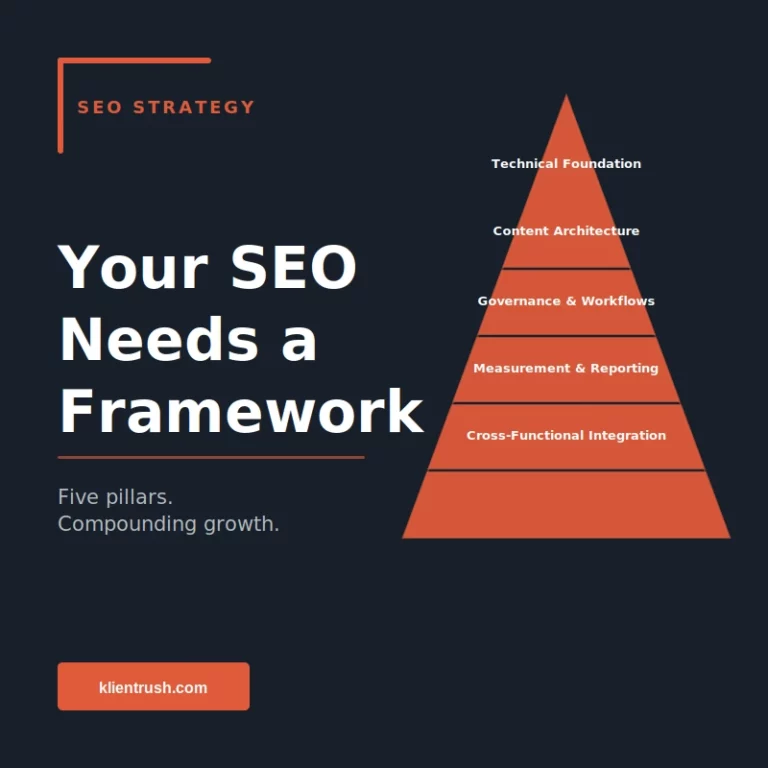

Enterprise SEO isn’t a bigger version of small business SEO, it’s a fundamentally different discipline. When a site has thousands or millions of pages, spans multiple brands, locations, or countries, and requires sign-off from legal, IT, and multiple stakeholder teams before a single title tag changes, the playbook has to change too. Enterprise SEO is about building processes and technical foundations that scale, not just optimizing individual pages.
This guide covers what makes enterprise SEO different, the core pillars a strong program needs, common mistakes that quietly cost large organizations traffic and revenue, and how to measure ROI at scale.
Why Enterprise SEO Is Different
- Scale changes everything. A technical issue affecting one template can impact hundreds of thousands of pages simultaneously, for better or worse.
- Stakeholder complexity slows execution. Enterprise SEO recommendations often need buy-in from IT, legal, brand, and regional marketing teams before anything ships, so process and documentation matter as much as strategy.
- Multiple sub-strategies operate under one roof. A large organization might simultaneously need enterprise technical SEO, multi-location or franchise SEO, and international SEO running in parallel.
The SEO Pillars Every Enterprise Needs
1. Technical SEO Built for Scale
Crawl budget management, template-level fixes, site speed at scale, and structured data implementation all need to be solved once and applied everywhere, not patched page by page. A single template fix can unlock rankings across tens of thousands of URLs, which is exactly why enterprise technical SEO has such outsized ROI potential.
2. Location and Franchise Page Architecture
Multi-location businesses need a scalable system for location pages that avoids thin or duplicate content while still ranking each location for local search. This requires a template that balances consistency with genuine local relevance, something most franchise systems get wrong by either over-templating or under-resourcing individual locations.
3. International SEO and Content Governance
Global enterprises need correct hreflang implementation, market-specific keyword research, and a content strategy that doesn’t rely on direct translation. Alongside this, content and editorial programs at scale need clear governance so quality and brand consistency hold up across dozens or hundreds of contributors and markets.
Common SEO Mistakes at the Enterprise Level
| Mistake | Why It Hurts |
|---|---|
| Treating SEO as a marketing-only initiative | Misses critical technical dependencies that require IT and dev resourcing |
| No process for prioritizing and shipping SEO fixes | Good recommendations die in backlogs instead of reaching production |
| Templated location pages with no unique local content | Creates thin, duplicate content that struggles to rank in local search |
| Inconsistent or missing hreflang across international sites | Causes the wrong country or language version to rank in search results |
| No content governance across contributors and markets | Leads to inconsistent quality and brand voice that undermines trust at scale |
Reporting also needs to work differently at this scale. A single blended traffic number rarely satisfies stakeholders who each own a different brand, region, or business unit. Segmented reporting that ties organic performance back to the specific team responsible for it builds the internal credibility SEO needs to keep getting resourced.
How to Measure ROI on Enterprise SEO
At enterprise scale, the numbers that matter most are:
- Organic revenue by business unit, brand, or region, not just aggregate traffic
- Indexation and crawl efficiency across the full site footprint
- Rankings and traffic per template or page type, to isolate the impact of technical fixes
- Time-to-ship for SEO recommendations, since execution speed is often the real bottleneck
Enterprise SEO programs often take 6 to 12 months to show their full impact, since technical fixes need to be prioritized, resourced, and deployed through existing development cycles. But because changes apply across such a large page footprint, the ROI ceiling is typically far higher than for smaller sites.
Governance matters as much as strategy. Style guides, approval workflows, and clear ownership across contributors keep quality consistent as content and technical work scale across dozens of teams and markets, something that becomes far harder to manage after the fact than to design in from the start.
What a Strong Enterprise SEO Program Looks Like
An effective program combines deep technical SEO expertise with the project management skill to navigate large organizations, a scalable content and location page architecture, and clear reporting that connects SEO work to revenue by business unit. It also means building relationships with IT and dev teams early, since most high-impact enterprise SEO work depends on their resourcing and timelines.
Frequently Asked Questions
How is enterprise SEO different from regular SEO?
Enterprise SEO deals with much larger page counts, more stakeholders, longer implementation timelines, and technical complexity that smaller sites rarely encounter, like crawl budget management across millions of URLs or coordinating hreflang across dozens of country versions.
Why do enterprise SEO fixes take so long to implement?
Most enterprise SEO fixes require development resources that are shared across many competing priorities. The strongest programs build clear business cases tied to revenue impact so SEO work can compete effectively for engineering time against other roadmap items.
Should every location or franchise page be built the same way?
No. A consistent template is efficient, but each location page needs genuine local signals, such as unique service details, local reviews, and area-specific content, to avoid being treated as thin or duplicate content by search engines.
How do you prioritize SEO fixes across a huge site?
Prioritize by potential impact and effort: template-level fixes that touch thousands of pages with minimal development lift come first, followed by high-traffic page types, then long-tail or lower-priority sections. A clear scoring framework keeps the roadmap defensible when multiple teams are competing for the same engineering resources.
Do enterprise SEO teams need a dedicated in-house resource, or can an agency run the whole program?
Most successful enterprise programs use a hybrid model: an agency or specialist brings the technical depth and cross-industry experience, while an in-house owner handles internal coordination with IT, legal, and regional teams. Neither side alone typically has the full combination of expertise and organizational access needed to move quickly.
KlientRush builds enterprise SEO programs around scalable technical foundations, location and international architecture, and reporting that ties directly to revenue. Get in touch to see where your SEO stands today.